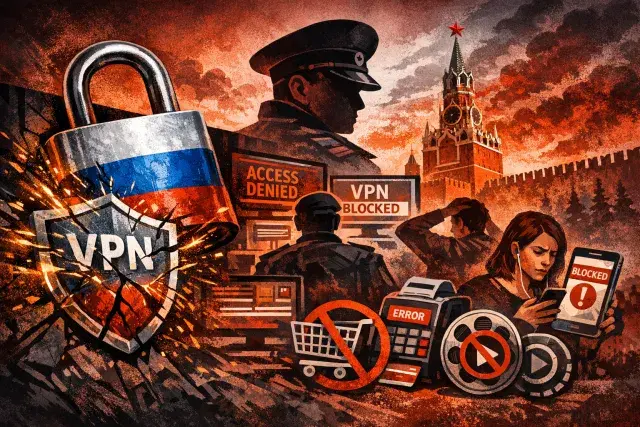

More Russian internet platforms are refusing access to users who connect through VPNs, extending a pattern that is moving beyond foreign sites and into everyday digital services inside the country. Reports from Moscow Times and Meduza indicate that major platforms, including the state portal Gosuslugi, retailer Ozon and streaming service Kinopoisk, have begun showing users that access is prohibited until the VPN is turned off.
The shift matters because VPNs in Russia are not only a privacy tool. They have become a practical way to reach blocked foreign services, preserve access to information and, in some cases, maintain routine online activity when restrictions disrupt ordinary connections.
From censorship workaround to target of enforcement
Russian authorities have spent years tightening control over the domestic internet, combining legal pressure, technical filtering and demands on platforms and telecom operators. VPNs sit at the center of that struggle because they can route traffic through encrypted tunnels, making it harder to enforce blocks on websites and apps that the state wants to restrict.
What appears to be changing now is the breadth of the response. Blocking a foreign social platform is one thing; denying access to local retail, entertainment and public-service portals for people using VPNs is another. That turns anti-circumvention policy into a direct burden on ordinary users, including those who may rely on VPNs for reasons unrelated to politics, such as security on public networks or access to work tools.
Technical pressure carries economic and social costs
The latest restrictions follow recent disruption linked to earlier anti-VPN measures. According to the reported accounts, new mechanisms aimed at limiting VPN use contributed to a large-scale outage of digital payment options on Good Friday before the problems were resolved. That episode highlights a recurring problem with broad network controls: when filtering becomes more aggressive, collateral damage often spreads beyond the intended targets.
Modern online services depend on dense, interlinked infrastructure. Measures designed to identify or interrupt VPN traffic can produce false positives, block legitimate connections and create friction across payments, authentication and customer access. In a system where state services, commerce and communication are increasingly digital, even short disruptions can affect households far removed from any political dispute.
The Kremlin frames security, critics point to isolation
The political context is also telling. Kremlin spokesman Dmitry Peskov said the blocks serve security in Russia and suggested normalization would come only after the end of the war against Ukraine. That framing places internet restrictions inside a wider wartime logic in which information control, platform access and communications monitoring are treated as matters of state protection rather than consumer policy.
At the same time, the Kremlin felt compelled to answer a video message from blogger Viktoriya Bonya, whose criticism reached a mass audience on Instagram. Her argument was less about abstract digital rights than about practical harm: when communication channels narrow, people facing emergencies can be left without reliable access to information or help. Her remarks about fear inside the system also touched a more sensitive issue, suggesting that officials may be reluctant to convey the real effects of these policies upward.
A narrower internet, with uncertain limits
Reports that Bluesky is also being blocked, despite its limited use in Russia, suggest the objective is not merely to respond to popular demand or platform size. The broader tendency is toward pre-emptive restriction: if a service could become a channel outside state control, it may be treated as a risk early rather than after it gains a large audience.
For users, that means the Russian internet is becoming more conditional. Access increasingly depends not just on whether a service exists, but on whether a connection method is considered acceptable by regulators and platforms under pressure. For businesses and state portals, the calculation is also changing. Compliance may reduce political risk, but it can also degrade usability and trust.
The immediate result is a more fragmented online environment in which technical workarounds are punished, routine services become less predictable and public criticism of digital restrictions is no longer easy to dismiss as marginal. Russia's internet controls are no longer confined to blocking distant platforms. They are reaching into the services people use to shop, watch, pay and interact with the state.