
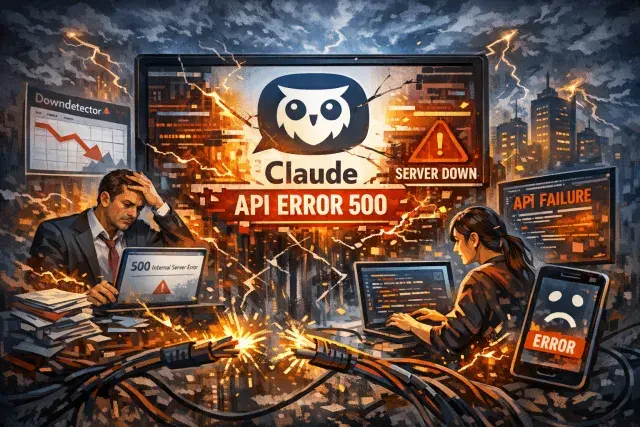

Anthropic’s Claude went down for thousands of users on Wednesday, with reports pointing to intermittent “API Error 500” failures across the company’s web app, developer tools, and related services. Downdetector showed nearly 8,000 user reports in the US, a reminder that even widely used AI platforms remain vulnerable to abrupt service interruptions.
Anthropic said on its status page that it was seeing increased errors on Claude.ai, the API, and Claude Code, later adding that the issue had been identified and that a fix was being implemented. The company did not provide a specific timetable for full recovery.
What the outage affected
The disruption appears to have reached both consumer and developer-facing parts of Anthropic’s platform. That matters because Claude is not only a chatbot on a website; it also operates as infrastructure for coding workflows, business tools, and applications that depend on API access. When an outage hits multiple layers at once, the impact extends beyond casual prompts and can interrupt work already embedded in daily operations.
An “Internal Server Error” usually points to a problem on the service provider’s side rather than on the user’s device or connection. In practical terms, that means refreshing the page or restarting an app may not solve the underlying issue if the failure is tied to backend systems, capacity constraints, or a broken deployment.
Why outages like this matter
AI assistants are increasingly treated as always-available software, yet they still rely on complex cloud infrastructure that can fail in ordinary ways: overloaded systems, faulty updates, database issues, or problems cascading across interconnected services. The more these models are folded into coding, writing, customer support, and research tasks, the more costly even a short outage can become.
This is also a trust issue. Reliability is now part of the product. For individual users, downtime is frustrating. For companies building on top of an AI model, it raises harder questions about redundancy, procurement, and whether critical workflows need backup providers or fallback systems.
What users can do while service is restored
Anthropic’s status page remains the clearest source for live updates. Beyond that, the most sensible response is operational rather than technical: shift urgent work to another provider if your setup allows it, and return to Claude once service stabilizes.
Check Anthropic’s official status page for incident updates.
Switch temporarily to another model or provider, such as GPT-4o or Gemini, if your tools support it.
Use older sessions or cached conversations when available, especially for reference work that does not require fresh responses.
Anthropic has not given an estimated time for full resolution, though past major outages across online services often clear within several hours once a root cause has been identified and a fix is underway.
Yahoo’s separate disruption adds to a busy outage day
Wednesday also brought a shorter disruption affecting Yahoo, with users reporting trouble accessing Yahoo Mail and AOL services. Downdetector showed at least 2,000 reports at one stage, though those figures later declined.
There is no indication from the available information that the Yahoo and Anthropic problems were connected. Still, the overlap underscored a broader reality of internet dependence: users often experience major digital services as permanent utilities, even though they remain exposed to failures that can surface without warning and ripple quickly across work and communication.